


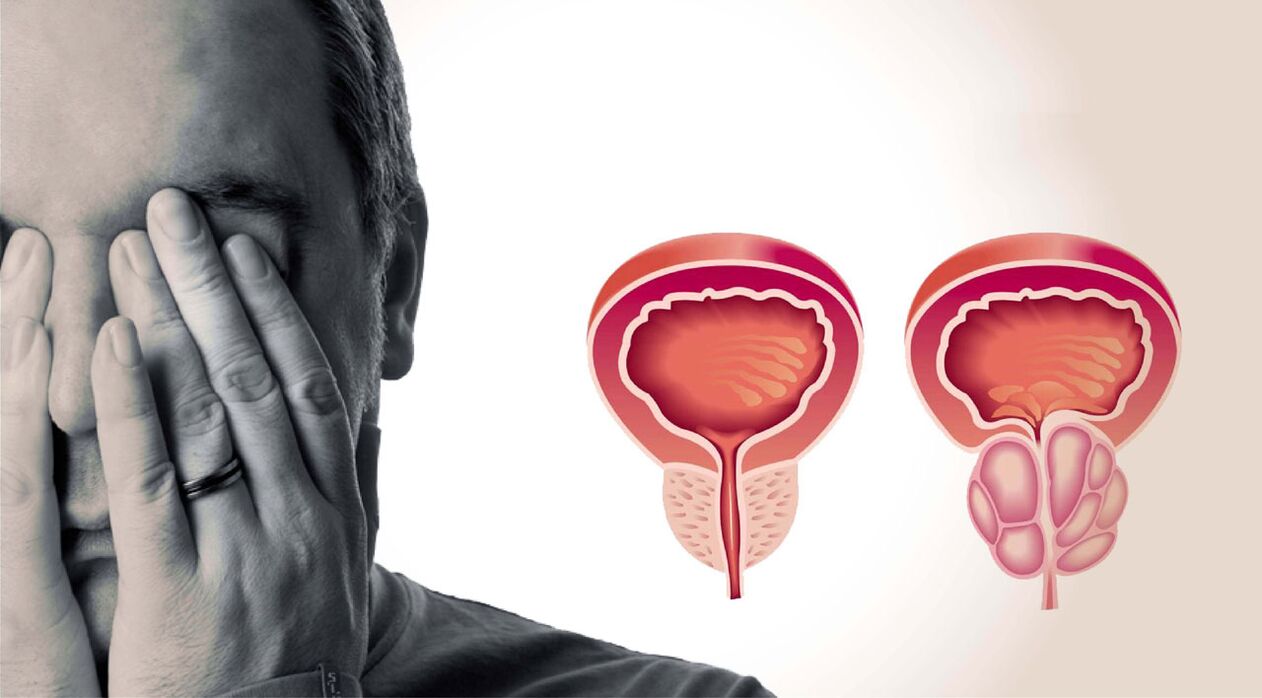
Chronic prostatitis is a disease that occurs most frequently in the practice of the urologist-andrologist.It is predominantly diagnosed in men who are at the peak of reproductive and sexual activity and ability to work.Therefore, timely treatment of prostatitis is crucial to restoring men's health as well as their social functions.
Causes of the development of chronic prostatitis
The chronic inflammatory process is followed by an acute stage caused by the activity of pathogenic microflora.If the cause is not identified in a timely manner and comprehensive treatment is not carried out, prostatitis transforms into a latent form with periodic relapses.
Infection can occur in 3 ways: ascending - through the urinary canal, descending - when urine with pathogenic bacteria enters the bladder, hematogenous - through the circulatory system (the infection is transmitted from other inflammatory foci in the body).
Causative agents of chronic prostatitis:
- pathogenic fungi
- coli
- corynebacteria
- gardnerella
- staphylococcus
- Trichomonas
- klebsiella
- mycoplasma
- enterococcus
- gonococci
- chlamydia
- parasites
- virus
- Proteus
In the chronic form of prostatitis in men, the inflammatory process can reappear even after the elimination of pathogenic microflora.In such cases, a violation of the innervation of the organ occurs with an autoimmune attack on the tissue against the background of primary inflammation.The examination does not reveal any infection.Therefore, patients are diagnosed with “chronic abacterial prostatitis.”
Prostate dysfunction is not always caused by an infectious lesion.There are a number of unfavorable factors that cause diseases.Among the most common:
- Decreased immune defenses due to hypothermia, poor lifestyle, bad habits and overwork.
- Poor circulation in the pelvis as a result of chronic constipation, sedentary work and lack of physical activity.
- congestion in the ducts of the prostate and other pelvic organs
- chronic infectious diseases (sinusitis, sore throat)
- Permanent injury to the prostate tissue due to increased loads on the perineal muscles and physical effort.
- irregular sexual contacts, sexual abstinence, interrupted sexual relations
- inflammation of the genitourinary system
- bad diet
- Previous STDs
Chronic bacterial prostatitis often becomes a concomitant problem with cystitis, urethritis, pyelonephritis, epididymitis and orchitis.In some cases, the infectious focus is not even in the genitourinary system.It could be tonsillitis, sinusitis, bronchitis, cavities, intestines or pneumonia that have not received proper treatment.
Urologists associate the appearance of a non-bacterial form of chronic prostatitis with congestion in the pelvic organs.When local circulation is disturbed, the vessels of the prostate overflow with blood, causing edema and stagnation of secretions.As a result, the prostate cannot produce the necessary amount of secretions and hormones.This leads to the development of an inflammatory process in the tissues.
Main signs of chronic prostatitis.
The symptoms of the bacterial form of pathology are similar to those of any infectious process.They progress with an increase in the amount of pathogenic flora and cause a serious deterioration in the general condition in the absence of adequate treatment.In the initial stages, chronic prostatitis is asymptomatic or has mild symptoms.Therefore, most men ignore the need to contact a urologist for an examination.
Postponing a visit to a specialized doctor to identify the cause and start treatment for prostatitis has serious consequences not only for the genitourinary system, but also for the psycho-emotional state.Potency disorders against the background of urinary disorders and a gradual deterioration in well-being in many men cause stress, apathy, increased irritability, severe fatigue and lack of appetite.Furthermore, premature initiation of treatment causes infertility in 40% of cases.
Symptoms of chronic prostatitis that require contacting a urologist:
- frequent and strong urge to urinate, weakened urine stream
- aching pain radiating to the perineum, groin, rectum, scrotum, glans, and sometimes sacrum
- pain when urinating (especially at the beginning and end of sexual intercourse)
- chills, excessive sweating (characteristic endocrine symptoms, since the prostate gland is part of this system)
- change in skin color in the area where pain is felt
- the release of a small amount of prostatic secretion from the urethra (during physical stress) against the background of a weakening of the tone of the organ
- potency disorder (decreased libido, erection problems, ejaculation due to a decrease in testosterone produced by the gland)
Any of the listed signs may indicate a disease, so a man should immediately contact a urologist for medical care.Also, do not forget about regular preventive visits to the doctor, since the disease can be asymptomatic.In such cases, the diagnosis is made by measuring the number of leukocytes in the prostate secretion.
Possible complications of chronic prostatitis.
Without timely treatment, the inflammatory process spreads.This is fraught with related problems, such as:
- epididymitis
- orchitis
- vesiculitis
- urinary incontinence
- Formation of stones, cysts in the prostate gland.
- reproductive dysfunction
- prostate adenoma
The most serious complication can be prostate cancer.
Methods for diagnosing chronic prostatitis.
Urologists receive the medical information necessary to make a diagnosis and determine the causes of the pathology after conducting a series of tests, as well as instrumental studies.At the first consultation, the doctor takes a history, questions the man about disturbing symptoms and performs an examination.The presence of discharge from the urethra, skin irritation and rashes in the external genital area is determined visually.Also in this situation, a digital rectal examination is indicated to evaluate the size, structure and sensitivity of the prostate.
Basic methods for making a diagnosis:
- general urine test
- urine bacterial culture, urethral smear
- microscopic examination of prostate secretion
- endoscopic examination of the urinary tract
- Ultrasound of the prostate gland (transrectal)
- PCR Test for STD Pathogens
A PSA test is performed to detect prostatitis to exclude adenoma and prostate cancer.In some cases, a tissue biopsy is indicated to clarify the diagnosis, followed by histology of the samples taken.If there are problems with reproductive function, men are prescribed a spermogram and a MAR test.
Treatment of chronic prostatitis.
Neglected conditions are difficult to correct.However, with an integrated approach to treatment, long-term and stable remission can be achieved.To do this, it is necessary to eliminate the cause of the inflammatory process and increase the body's resistance.This effect is achieved by selecting individual therapy, taking into account the man's age, the stage of prostatitis, the state of the immune system and the severity of symptoms.In extreme cases, when there is a threat of serious complications, surgical treatment is recommended to the patient.
Basic therapeutic methods for chronic prostatitis:
- taking antibiotics
- symptomatic therapy
- use of anti-inflammatory medications
- Physiotherapy to normalize blood circulation, relieve swelling.
- diet correction, lifestyle.
Completing a comprehensive treatment for chronic prostatitis allows you to eliminate the causes of the inflammatory process, relieve pain, and also improve the general well-being of the man.An essential part of the therapy is the restoration of the body's protective resources.If prostatitis has a non-bacterial etiology, taking immunomodulators can prevent autoimmune aggression.
Modern physiotherapy for prostatitis.
Physiotherapeutic methods quickly relieve many symptoms and provide stable improvement in most men.At home it is recommended to take warm baths regularly, but the water should not be too hot.
Clinical physiotherapy methods for chronic prostatitis:
- Ultrasound therapy.Exposure to high frequency waves.
- Ultraphonophoresis.A combination of ultrasound treatment with effective prostatitis medications, which are administered during the procedure.
- Magnetotherapy.Low frequency magnetic field therapy.
- UVT.Impact of shock waves on the immediate cause of prostatitis: congestion and inflammatory processes.
- Darsonvalization.Application of high frequency pulsed current.
- Galvanization.Low frequency direct current treatment.
- ultrahigh frequency.A method of relieving the symptoms of chronic prostatitis by influencing an electric field through capacitor plates.
Electrophoresis gives a clear result.Accelerates the delivery of medications to affected tissues.Thanks to this, it is possible to reduce the load on other organs, which is important for overall health, since chronic prostatitis requires serious treatments.Shock wave therapy procedures provide a positive effect.After them, most men notice a decrease in prostate discomfort, pain relief and an improvement in erection after the first session.
Physiotherapy is an auxiliary method in the treatment of prostatitis.The reduction in the severity of symptoms, as well as the speed of recovery in general, depends on the individual reaction of the body to the chosen method of exposure.Some courses last several weeks or even months, but help chronic prostatitis in men reach a state of stable remission.
Qualified urologists in a modern clinic can develop an optimal treatment plan for this pathology.